


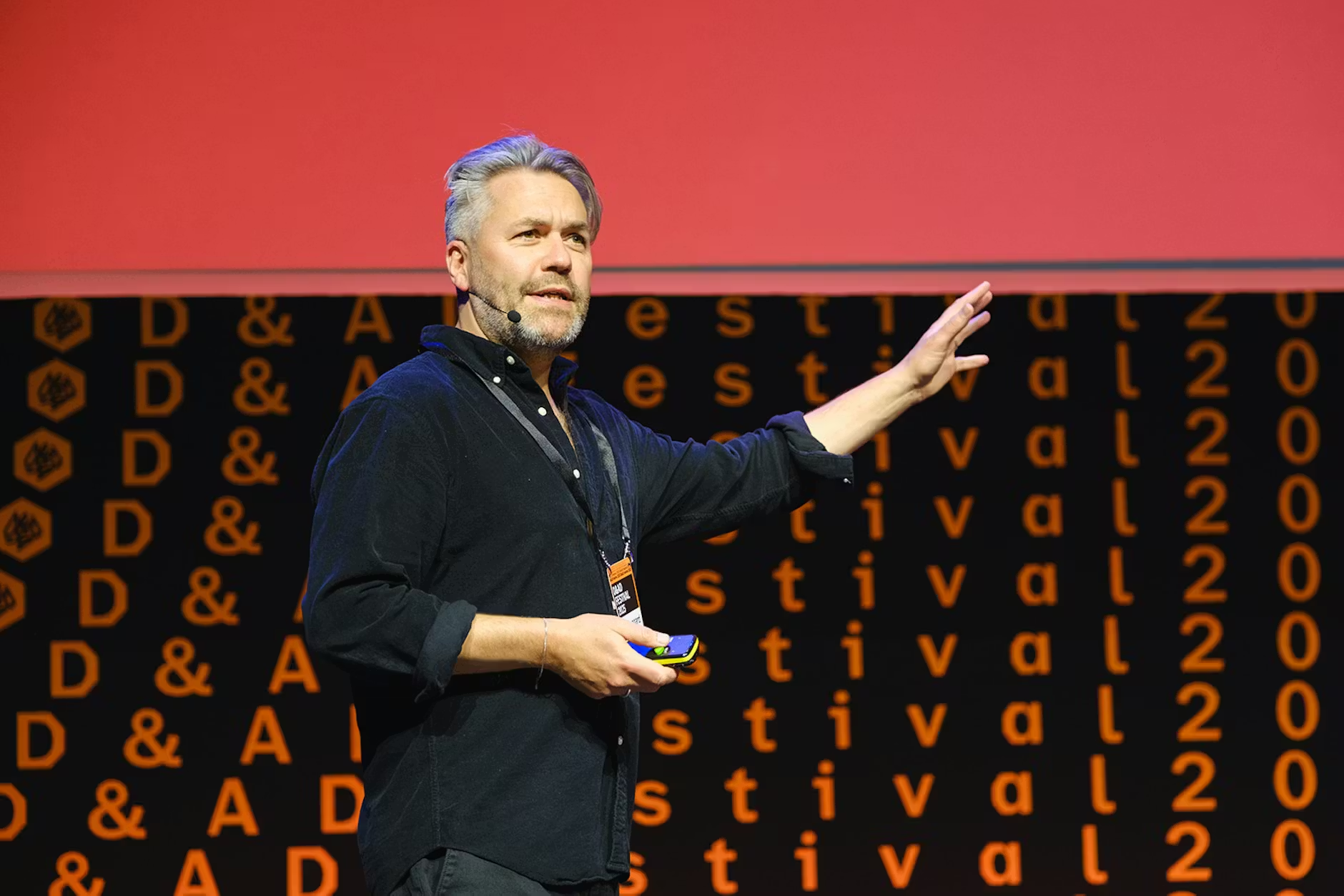

Nils Leonard: It’s ‘worst time in human history’ to start a creative company, ‘so start’
The Drum catches up with the Uncommon founder at D&AD Festival, where he levels on why now is a perfectly good time to start an agency and how you might do so.
If Uncommon founder Nils Leonard were to start an agency today, he wouldn’t make advertising in the way he used to, he says.
We are speaking with him at D&AD, where, like many speakers in the advertising and design industries, he’s trying to make sense of challenges faced internally and externally.
For Leonard, the weight of negative talk, particularly on LinkedIn, would have us believe that “this is the worst time to start a business in human history.” He later adds, “So start.”
Leonard reasons that while this sense of doom seems particularly magnified at the moment, there have always been naysayers. “When we started, we were heading into Brexit. There’s never a good time to start a business.”
His point about ignoring traditional advertising is that “making things” could be a much better route to take. This is what Uncommon has come to call “narrative objects.”
“Imagine a company that came out now and made a series of things that felt more like pieces of design than an ad, but it was making them on behalf of brands, yet also did it for itself,” says Leonard.
Those familiar with Uncommon’s work will know that the agency is already taking this route, the Rat Boot being a case in point, yet Leonard wants to take this further.
While agencies balancing self-initiated and commercial work is nothing new, Leonard seems much keener on the former.
He hints at how the studio is heading towards “physicality, retail, design, environment, architecture” with its future work. In step with this, many of his references are from the world of design and architecture – the likes of Es Devlin and Thomas Heatherwick.
Uncommon’s new work will be “at a larger scale” and he hints that “there’s a project in the US that’s in production” that he is excited about, as well as a retail space.
Given that a large part of the audience Leonard spoke to will have been younger designers and creatives starting out, will it be possible for them to have the luxury of creating work without clients in mind?
“If I were already working somewhere, then I would try to prioritize a bit of my time and money to go and push these things. You’d be surprised what people will fund and start,” says Leonard, who also advocates going ahead without funding where possible: “You’d be surprised how cheaply you can make things sometimes”.
Perhaps his most practical perspective, drawing on Uncommon’s own experience, is to learn all core skills and bring them in-house. “Learn to design, script, draw, write, edit, code, dialog, organize, prioritize,” he advises, adding: “We just wanted to remove as many of those barriers – and frankly people – as possible”.
The idea of starting again is a useful metaphor for Leonard. If he were to start again today, he wouldn’t just build stories around physical objects and eschew traditional advertising models, he’d also be completely anonymous, or “disappear,” as he puts it, to create a sense of intrigue.
What’s a Rich Text element?
The rich text element allows you to create and format headings, paragraphs, blockquotes, images, and video all in one place instead of having to add and format them individually. Just double-click and easily create content.
Static and dynamic content editing
A rich text element can be used with static or dynamic content. For static content, just drop it into any page and begin editing. For dynamic content, add a rich text field to any collection and then connect a rich text element to that field in the settings panel. Voila!
How to customize formatting for each rich text
Headings, paragraphs, blockquotes, figures, images, and figure captions can all be styled after a class is added to the rich text element using the "When inside of" nested selector system.
Quote can go here
