


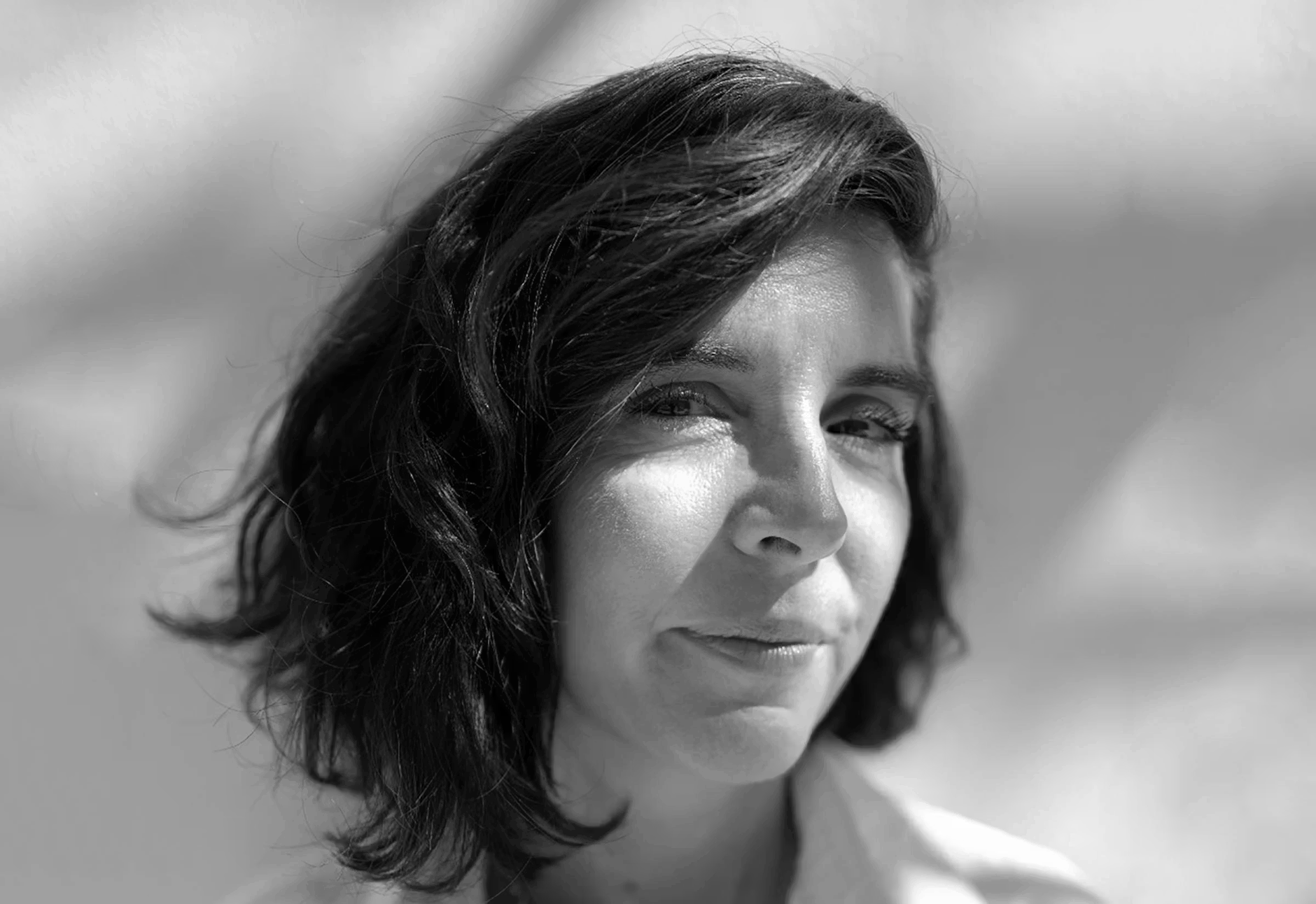

‘Push limits, but don’t be an asshole’: Uncommon’s Lisa Smith on tenacious design
The global chief design officer and D&AD president talks tenacity, transformative work and why putting design at the heart of everything is the ultimate power move.
Lisa Smith dials in to our interview from New York, where she is now based, but her story starts in the UK, as a “sporty kid” who spent most of her childhood in leisure centers. She and her brothers all played rugby, field hockey and swam, totally “consumed” by it all. She wasn’t particularly academic and tells me, in all honesty, she “didn’t love it.”
Smith admits that she had numerous ambitions, but that they weren’t too “broad,” and that she believed she would pursue a career in sports or teaching. Her parents, meanwhile, were keen for her to study economics at university. “It’s funny how when, as kids, you get told to do something or not do something and it shapes your resistance to it,” she explains. “I love my dad, but when he passed away, I went and did art. It’s definitely acts of mini rebellion.”
While applying for a foundation art course, she vividly recalls being told to “go away” and read John Berger’s book Ways of Seeing and come back with a drawing. “So I drew my boyfriend’s car engine all summer,” she laughs. She got on to the course, which encompassed textiles, ceramics, painting and jewelry making. Smith “loved it all” and felt a bit overwhelmed when it came time to focus on one specialism.
A tutor at the college was the wife of photographer David Stewart. She explained that graphic design might be a good route for Smith. “He [Stewart] was very theatrical. He made films where people turned into cabbages and their heads popped up. It was very surreal and crazy. And she explained that graphic design can lead you to all these parts. So I saw graphic design as the umbrella.”
After getting her degree in graphic design at Bath Spa University, Smith was curious about the advertising world. “I knocked on the door of a very famous ad agency because they made singing and dancing pot noodle ads. And I was like, ‘I want to make this, these are hilarious and they’re weird and they’re wonderful,’” Smith says. “But they were like, ‘You need to go away and find a writer."
Eventually, she did get her foot in the door, at a design agency called Browns. The studio was founded by British artist Jonathan Ellery. “John let me make mistakes,” remembers Smith. “There was time to teach and the patience for it.” During that time, Smith recalls that her mum advised her to become “indispensable” and that she needed to be memorable to the team, which is something Smith took to heart.
“John would say that everything should be award-winning. And he didn’t mean enter awards. It was a metaphor for pushing the boundaries, changing the conversation, doing something brave.”
It’s something that Smith has always taken with her since. “Don’t be an asshole, but push to the ultimate limits,” she says. “Sometimes, you know, you’re fighting bureaucracy and politics and it gets ordered down and you can only fight so much. But I was always taught to have that tenacity.”
Throughout her career, Smith has been involved in numerous pivotal campaigns, but she says that there will never be anything like what happened at Chobani. “The stars, the moon and every single planet aligned. It was a founder who was at his 10-year mark, who was open and receptive to the brand transforming and being able to grow. He let design be put into the heart of it.”
At the time, Smith says, people thought she was crazy – “You’re going to work for a yogurt company?” – but as she recalls, it was unlike any business she’d ever seen. The chief marketing officer was a leader who built from the heart, employing ex-refugees, fighting for people and running a truly people-led company – something Smith deeply admired. She oversaw a rebrand that “transformed” Chobani, which expanded its product line and, ultimately, increased customer loyalty and growth.
Another project that has truly stuck with Smith happened while she was head of design at Wolff Ollins. It was for The Met and, as she puts it, “scarred her” a little bit due to the intense backlash. It was something she had never experienced before and found it quite tricky to let wash over her.
In 2017, the Metropolitan Museum of Art unveiled a new identity that included two typefaces, a rich color palette and a new logo, while officially embracing its longtime nickname: The Met. The redesign replaced the iconic 1971 ‘M’ and marked a bold shift for the 146-year-old institution.
“[It’s hard] when you have very famous creatives in the New York Times, that you respect, backlash against in such a vocal way,” explains Smith. “Look, everyone is entitled to an opinion. Now, I would say it’s more mixed, because I think more people are standing up for it, but God, they’re still so impassioned about it, but it has such a good strategy, that’s why it has stood the test of time.”
Another pivotal moment in Smith’s career occurred in 2021, while she was at Jones Knowles Ritchie, when she led Burger King’s first rebrand in 20 years. Her team refreshed the brand’s visual identity, bringing back a retro-inspired logo and pairing it with custom illustrations, a rounded typeface and close-up food photography. The goal was to elevate perceptions of quality and taste throughout the entire brand experience.
“It didn’t start out as a rebrand. It started out as an initiative around moving all the nasty ingredients from the food,” she notes. “But sticking claims on products wasn’t going to solve anything. You go into a fast-food restaurant, you’re not expecting to be preached at. The problem is, people didn’t feel good about eating Burger King food because it looked crummy and it looked dated.”
The Burger King identity from the 1990s felt outdated and ill-suited for digital platforms. Smith’s team modernized a classic logo, overhauled the system and put food at the heart of the design, with bold colors, juicy typography and visuals inspired by the Whopper and flame-grilling.
Throughout her long career, Smith has always believed that design has the power to transform and solve real problems. It’s something that attracted her to her new role at Uncommon, as the creative studio’s first global chief design officer, and she says design has always been at the heart of everything the agency does. “Nils and I talk about the fact that design is everything. I read somewhere – and my blood boiled – about design being a commodity and that we’ve got to move past it. And I was like, ‘Whoa, what a big misunderstanding of what our industry and the power of what design is.’ It’s the power of all these types of creatives coming together to make things happen.”
Smith believes that being able to put the brand at the center and extend it across every touchpoint is extremely powerful. Working with one agency that understands the full consumer experience creates a cohesive, distinctive brand that is far more effective than managing multiple agencies in silos.
A defining moment for Smith came earlier this year when she was announced as the president of D&AD. “D&AD is in my heart, it’s in my DNA,” she says. Involved with the organization in some way since the start of her career, she now feels privileged to have her name alongside past presidents, many of whom she considers some of the most iconic creatives in the industry.
“Michael Wolff was president! I mean, these are my heroes, so to have my name invisibly etched somewhere on that list is already such a privilege. We’ve got to really push the creative agenda and make sure we’re really thinking about creative excellence versus how you make it more accessible for everyone.”
Smith is clear that D&AD should never feel elitist. She acknowledges that some established creatives (“on LinkedIn”) are intimidated by new developments, like AI, and spend more time complaining and writing posts than creating. For her, the focus has always been on making and nurturing new talent. She explains that D&AD channels resources back to emerging creatives, yet many people still don’t realize it’s a nonprofit. At the same time, she recognizes the weight D&AD carries in the industry, where winning a Black Pencil remains the ultimate mark of creative excellence.
“I want to make sure we’re getting rid of the guff that’s sitting in the middle, all the noise, all the stuff that’s dragging the industry down, and really focus on the most excellent work,” she says. “If you’re still in that fight for creative excellence, you’ll keep fighting. You never give up. Every year, I’m always like, ‘No one got my piece of work. They didn’t understand it!’ But you go again. You have to have a goldfish mindset, move on to the next one.”
She highlights FCB’s ‘Spreadbeats’ work for Spotify. “That work was amazing. You will hit the jackpot and the jackpot will keep ringing. Every creative wants that feeling. Don’t tell me you don’t. Once you’ve won a pencil, you’re addicted and you want more.”
What’s a Rich Text element?
The rich text element allows you to create and format headings, paragraphs, blockquotes, images, and video all in one place instead of having to add and format them individually. Just double-click and easily create content.
Static and dynamic content editing
A rich text element can be used with static or dynamic content. For static content, just drop it into any page and begin editing. For dynamic content, add a rich text field to any collection and then connect a rich text element to that field in the settings panel. Voila!
How to customize formatting for each rich text
Headings, paragraphs, blockquotes, figures, images, and figure captions can all be styled after a class is added to the rich text element using the "When inside of" nested selector system.
Quote can go here
