


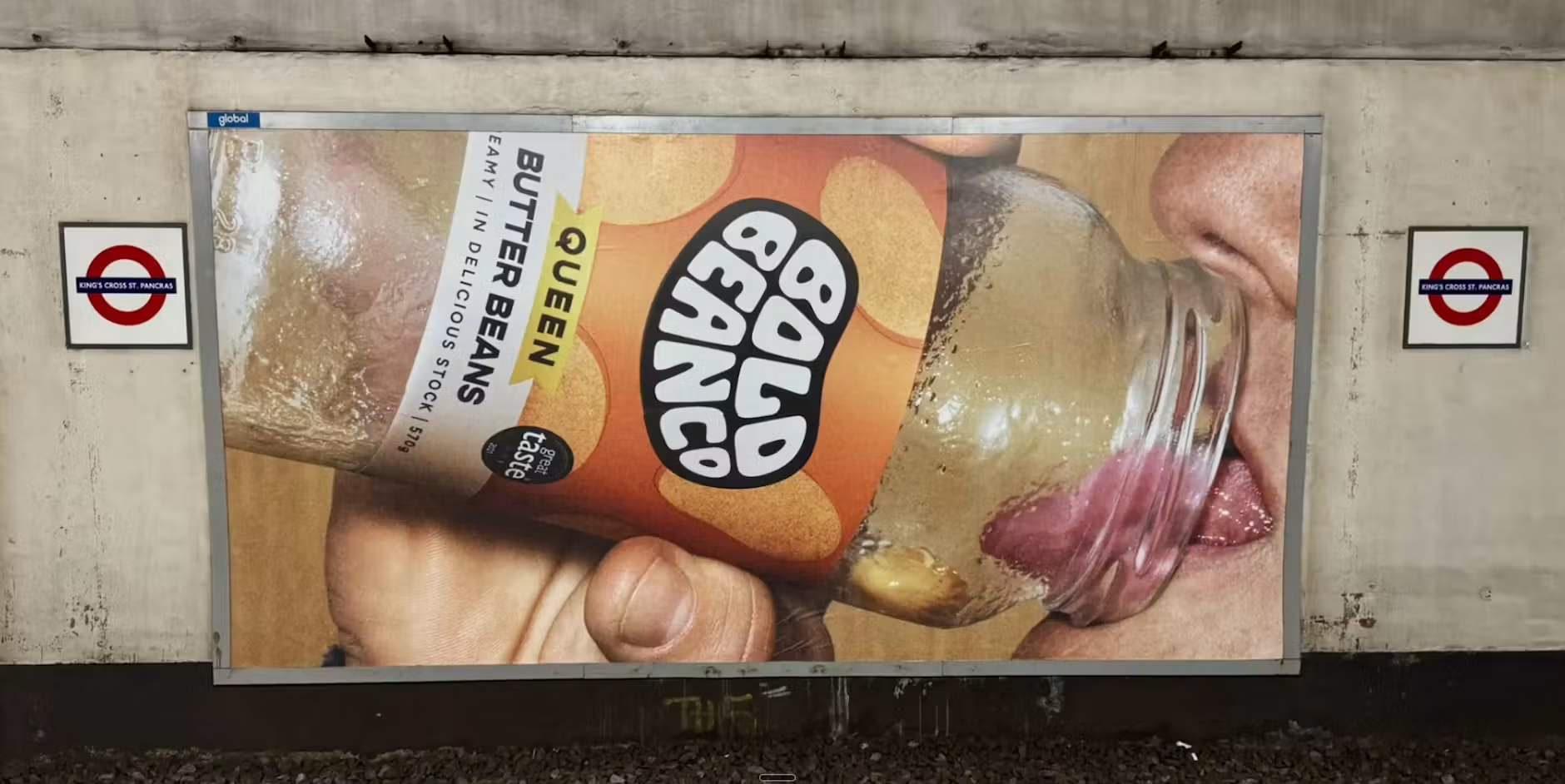

Bold Bean has the fans. Can Uncommon help it reach everyone else?
Jar-licking posters turn customer devotion into an arresting debut campaign. The challenge is convincing shoppers who still think beans are boring.
While The Drum was photographing a Bold Bean poster on the London Underground, a stranger stopped for a chat. Not to ask what we were doing, but to say how much they love the beans.
That is Bold Bean Co’s great strength. People who have tried the product can’t shut up about it. The brand says its repeat rate is 10% above the category average and that word of mouth has carried it to 12m jars sold.
Founder Amelia Christie-Miller fell for jarred beans in Spain, where, she says, they have been treated “with reverence for generations.” She started Bold Bean Co in 2021 to bring that tradition to the UK. She picked a good time to launch. “There is no doubt that megatrends like gut health and fiber are boosting the demand,” she tells The Drum.
Taste and quality were key from the start; her first two hires were a recipe writer and a product quality developer. There is now a whole team dedicated to finding beans “sourced from the freshest harvest, tested for thin skins and creamy centers and cooked until they’re meltingly perfect.” The Drum bought a jar of the flagship Queen Butter Beans. She’s right. They are delicious.
Scaling without sampling
But word of mouth can only scale a brand so far. The harder job is to convince those who aren’t in the know, which is why the brand has just run its first paid campaign, ‘Obsession,’ created by Uncommon. Christie-Miller has an unusual goal for it. “My hope is that in the future we won’t be able to run a campaign like this,” she says. She pictures a day when everyone knows beans are delicious and “being obsessed is a dull and unoriginal thing to say.”
In other words, the ‘Obsession’ idea only works while beans equal boring. “For so long this food group has been characterized as tasteless hippy fodder at the back of the cupboard,” says Christie-Miller. Uncommon’s posters are anything but bland. What they depict tips the campaign, in Christie-Miller’s words, “into the bizarre.”
One poster shows a tongue licking the last of the stock from inside a jar, blown up to billboard size on the platform wall, with every taste bud and pore in high definition.
On another, a hand is jammed into the neck of a jar like a foot squeezing into the wrong glass slipper, fingers reaching for the last few butter beans. Others have deadpan one-liners in which the beans matter more than flatmates, friends and manners and theft is totally reasonable.
Christie-Miller calls the work “bold and a little bit ridiculous” and says, “That’s why we love it. I understand if it made someone wince.”
What the posters don’t do is tell the uninitiated what’s so special about the product to provoke such extreme behavior. No provenance, no awards, no explanation of why it costs more than tinned beans. Nigella Lawson, Jamie Oliver and Jessie Ware have all publicly endorsed Bold Bean. None of them gets a mention.
One job
That was the plan. The brand “wanted the images to have their moment without cramming reasons to believe around the edges,” says Christie-Miller. “We know that once people taste the beans, they’re sold. So the posters had one job: introduce Bold Bean and make people curious.”
The timing was deliberate, too. “The business is finally ready for it. We’re in every major supermarket now, alongside the independents who backed us first, and our website is thriving. So if something stops you on the Tube, you can actually go and find us.”
Tobey Duncan, chief strategy officer at Uncommon, argues that the best way to elicit that curiosity is to show how real fans behave. “We could have made a conventional campaign around taste or quality, but the intensity of the existing fandom is actually one of the strongest product proof points.”
And the idea is Bold Bean’s to own, he argues. Asked whether the same lines would work just as well for chocolate, ice-cream or peanut butter, Duncan replies: “What makes the idea belong to Bold Bean is that it’s true. People really do eat them straight from the jar, guard the last beans and think twice about sharing. We’ve exaggerated something real rather than invented a fiction and attached it to the brand.”
Christie-Miller, asked the same question, is clearer still. It works, she says, because nobody expects anyone to get so passionate about beans: “Bean obsession is so at odds with public opinion of the food group.”
Real people, real flavor
Christie-Miller agrees with Duncan that the scenes reflect a truth. None of them “came out of a brainstorm,” she says, and two of the people on the posters are genuine customers. “Putting real obsession at the center felt so much more honest than borrowing famous names.”
Duncan’s test for the jar-licking was whether the audience “feels complicit in the obsession, not repelled by it.” Complicit is a good test. These posters show real fans, doing real fan things, and real fans will no doubt lap it up.
But with only 2.7% market share, fans are in the minority. Christie-Miller herself says: “Most people in the UK have never heard of us and plenty of them have never given beans a second thought.”
Clearly, the campaign strategy involved some bold decisions and so did the creative execution. Having eschewed the tried-and-tested benefits most food brands consider essential, Uncommon and its team of stylists and photographers gave the posters a look and feel that is also unusual for the category. Instead of slick, glossy images, they went for flat light and everyday backgrounds.
That warts-and-all aesthetic is a little surprising, given that the founder says Bold Bean’s job is to make beans “desirable and aspirational.” Christie-Miller has even turned down requests in board meetings to “consider tins for the margin” because “beans need to look like something worth falling in love with.”
It is hard to imagine a campaign like this getting through research and sign-off at a big food group. But a founder-led challenger brand has a lot more freedom to do things its own way and, as Christie-Miller says, “Being bold is one of our values.”
That boldness has paid off for the brand so far. NielsenIQ data for the 52 weeks to August 8 has sales up 90.4%, adding £7.7m, and the brand says a quarter of its sales come from people who weren’t buying beans at all before they found Bold Bean. Christie-Miller says that’s the metric she’s most proud of. “We’re not just nicking share from other beans. We’re bringing new people to them, which is the whole point.”
Meanwhile, at M&S
Bold Bean may now be a victim of its own success. Others have noticed the buzz in the once sleepy supermarket aisle. In July 2026, M&S relaunched its own-label beans in glass jars for the extremely low price of 55p. Christie-Miller took to LinkedIn, calling it “damn scary” and wondering how on earth they had made them so cheap.
The post made headlines. But look behind the column inches and the 55p jars turn out to be from M&S’s everyday range, which isn’t competing in the same arena as Bold Bean’s Queen Butter Beans. Plus, they come in a smaller jar. The closer comparison is M&S’s Collection Giant Butter Beans, which were already on sale months earlier. Kilo for kilo, they are only around 10% cheaper than Bold Bean, a relatively modest differential for an own-label product against a brand name.
That slightly higher price could well be justified. An independent newspaper taste test in May 2026 named Bold Bean’s Queen Butter Beans best overall, with the reviewer calling the flavor among the best they’ve tasted. The M&S Collection jar merely had “a pleasant, nutty taste.” The Drum’s own unofficial side-by-side tasting concurred: we found Bold Bean genuinely moreish and a clear winner on flavor.
Three months on, Christie-Miller is more relaxed. “This is actually a great sign of a changing food culture,” she now says of M&S’s arrival. “We’ve spent five years showing people that beans can be delicious and 85% of our growth is incremental to the category, so I like to think we’ve played a part in this.” She adds: “Whatever it is, more beans in more baskets is happening and it’s what our mission is centered around.”
Taste first
Given how much rides on first-hand experience, the ‘Obsession’ campaign devoted considerable resources to sampling: via Deliveroo, through its biggest creator send-out yet and at The Beanery, a three-day London pop-up that gave away 1,500 lunches and drew lines too long for The Drum to get through.
It’s a shame you can’t taste a poster. The campaign is designed to stop people in their tracks without saying a word about taste, letting curiosity do the selling. “It’s a big bet for a brand our size,” says Christie-Miller, “and I’m a mix of nervous and very excited about it.”
The risk is that people notice them on the Tube but never reach for a jar in the supermarket. Taste is why the fans are obsessed and everyone else is being asked to deduce it from a picture of an almost empty jar.
The stranger who stopped The Drum had nothing to say about the poster. It was the beans he wanted to talk about.
For the record, one mouthful converted us too. But we will be using a spoon.
What’s a Rich Text element?
The rich text element allows you to create and format headings, paragraphs, blockquotes, images, and video all in one place instead of having to add and format them individually. Just double-click and easily create content.
Static and dynamic content editing
A rich text element can be used with static or dynamic content. For static content, just drop it into any page and begin editing. For dynamic content, add a rich text field to any collection and then connect a rich text element to that field in the settings panel. Voila!
How to customize formatting for each rich text
Headings, paragraphs, blockquotes, figures, images, and figure captions can all be styled after a class is added to the rich text element using the "When inside of" nested selector system.
Quote can go here
