



‘Dancing on tension’: How The Ordinary and Uncommon are pushing category norms
The agency has jumped from 180th to fourth in the mid-year update to the World Creative Rankings, in part because of a run of award-winning work for The Ordinary. Here’s how the partnership is shaking up the brand’s marketing approach.
When The Ordinary was launched in 2016, it was as a rebuke to the opacity and pseudo-scientific language of the beauty industry. Its products hit shelves with the active ingredients printed prominently on the packaging, at a cost that made established competitors look overpriced.
After other beauty brands adopted the same visual codes and language, however, its founding positioning needed a fresh expression to make its original challenge to the category feel relevant again. In 2024, it hired Uncommon Creative Studio to do exactly that. The partnership has since produced a series of campaigns exposing the gimmicks used to sell skincare. The work has helped propel Uncommon up The Drum’s World Creative Rankings. More importantly for The Ordinary, it has transformed a brand position into something people can actively buy into.
Global brand director Yasmin O’Neal recalls: “The idea that Uncommon landed on for us was that people think that things are maybe reassuringly expensive because of all the misinformation and the marketing fluff that’s out there in the world. This is the enemy for us versus. So rather than saying, ‘We’re high quality and our prices are affordable and accessible,’ we wanted to address that.”
There’s also a practical reason for this approach. The Ordinary is affordable because it genuinely does have a small media budget and simply can’t force product advertising into consumers’ consciousness through repetition.
O’Neal continues: “Because of that, we have to have unexpected messages that people genuinely want to talk about in order to get that reach. And the challenge we always give our team is, is this a message that you want to talk about with your friends on a Saturday night? Because if I don’t want to talk about this campaign with my friends, let’s not put it out into the world. And it’s a Saturday night because it’s not like a Tuesday at work. This is about genuinely being in culture.”
Uncommon’s co-founder Nils Leonard says finding the right way to tell The Ordinary’s story took time. The agency initially experimented with long-form copy to articulate the brand’s model and explain why its products cost less than many competing formulations, but quickly realized that no one was really listening to that message.
“We had to collide with the fact that there are hundreds of buzzwords, all of which have been used to sell us stuff that’s inflated,” he says. “And suddenly, you start having that conversation about that tension. All the best work that we’ve done has found a way to dance on tension of some sort. And that’s when it started to really chime.”
‘The Periodic Fable’
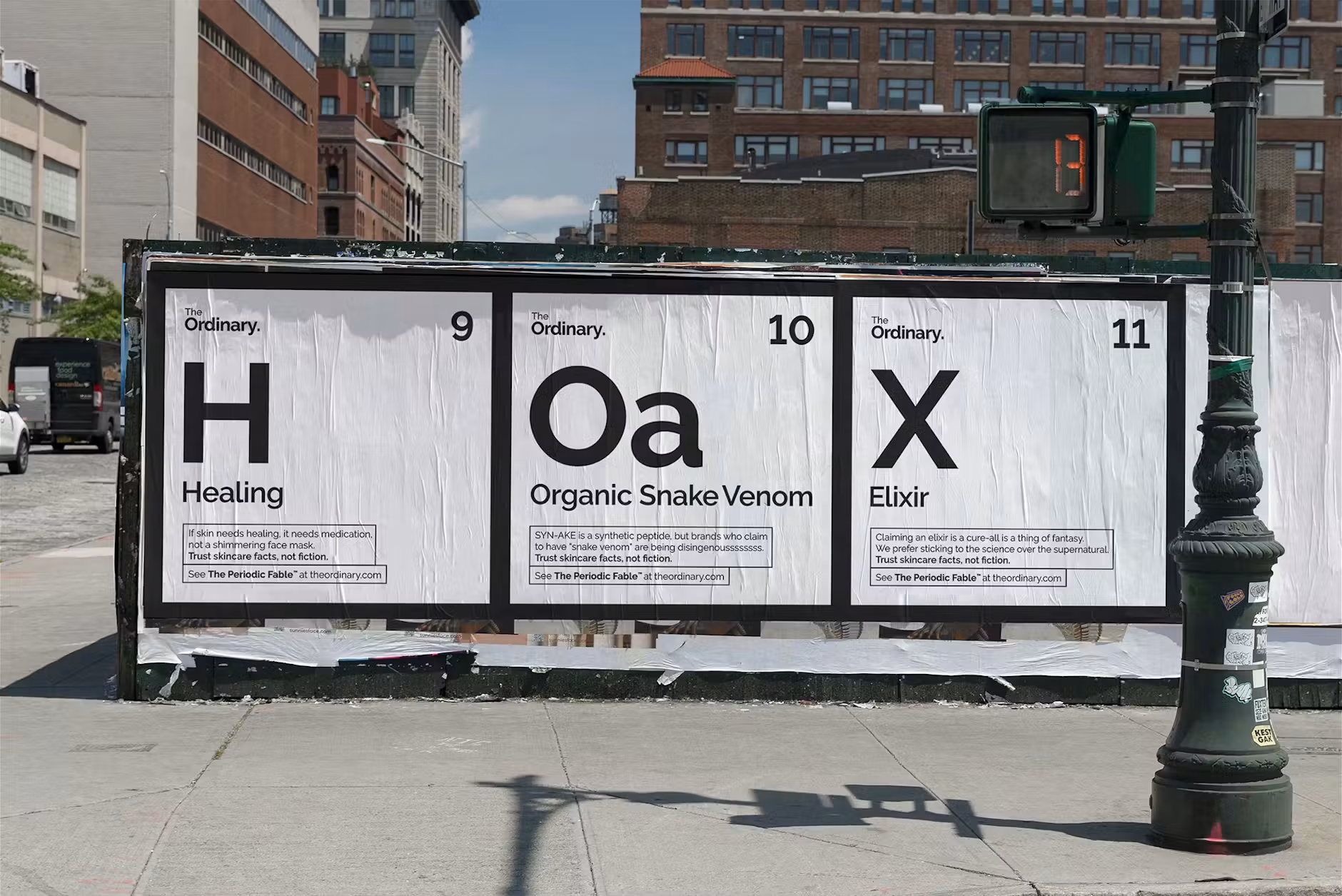
Arguably, the most successful piece of work has been ‘The Periodic Fable,’ which replaced the elements of the periodic table with 49 questionable beauty terms, including “medical grade,” “pore-erasing” and “magic.” It recently won a Grand Prix at the Cannes Lions Festival and has amassed numerous other wins and nominations for other programs, including the D&AD and Clios.
“It was an endeavor. We had to find the terms, unpack them and present them to the world in a form that they understood,” O’Neil says. “It might feel like a misdirect to spend a lot of time talking about a load of buzzwords that the industry uses, but what that says about their product speaks volumes, without us having to say it.”
Its uncompromising presentation also distinguished it from the more cautious language typically used by brands when addressing misinformation.
“Consumers had never really seen anything like this before. It was very black and white, saying, ‘This is false,’” says O’Neil. “There are very few brands willing to go out there and say, ‘No, we’re putting our name on this. We’re putting our brand reputation, our business, on the fact that this is false.’”
The conversation continued well beyond The Ordinary’s own channels. O’Neil says awareness increased in every country measured by the company. It achieved an overall reach of 85 million people, with the film garnering over 4.2m organic views and over 1.7m views on TikTok.
According to its research, 58% of US consumers said the campaign has made them more likely to see The Ordinary as the most trustworthy beauty brand, leading to a 10% uplift in purchase intent among US consumers.
O’Neil says an important indicator of its success was the community response that persisted in the months following the launch. People homed in on terms that felt relevant to them. Some questioned the idea of ‘natural beauty,’ for example, while others focused on products described as ‘beauty inspired’ or ‘medical grade.’
Its spread illustrates what Leonard considers an increasingly important characteristic of modern creative work: the ability to leave space for participation. “Someone said the best of our work is an idea with a hole in it,” he says. “What they mean by that is that we leave it unfinished enough so that other people, influencers, whoever they are, anybody with an opinion, can go inside and make their own version of it.”
Rather than dictating one polished interpretation, ‘The Periodic Fable’ gave people dozens of phrases to dispute, mock or explain.
“That’s really the future of ideas; to create something that everyone can make their own version of,” Leonard says. “‘The Periodic Fable’ spread because people use their own words; they all found their own way with it.”
From a table to a supermarket
‘The Markup Marché’ extended that thinking from an information-rich campaign into a physical retail environment.
Rolled out in London, Toronto, Paris, Melbourne, Mexico City and São Paulo, the activation presented familiar groceries using the euphemisms, premium packaging and excessive prices commonly found in beauty. Alongside the $175.90 banana, which was marketed as an “all-natural energy boosting bar,” were a $195.50 “thirst-defying” coconut and a “glow-enhancing” avocado priced at $305.90. The goods had not changed; the description and presentation had.
It gave tangible form to The Ordinary’s central pricing argument. Consumers could be told that packaging and language distort perceptions of value, but confronting a luxury avocado makes the same point with considerably more force.
The activation also doubled down on Uncommon’s belief that brands should give creators something worth reacting to, rather than treating them purely as paid distribution.
The Ordinary would argue that it has always had that two-way relationship with creators. Each year, the brand brings selected creators into its headquarters where they visit its laboratories, meet scientists and learn how products are formulated.
O’Neil adds: “I often talk about The Ordinary and access – access to truth and science. But the feeling I want people to actually feel when they watch something or when they engage with us is enlightenment.”
Changing the organization
The work has begun to influence The Ordinary internally, too. When the relationship with Uncommon began, the company did not have a dedicated team responsible for what it now calls “brand voice” campaigns. It has since created a three-person unit focused on that work, separate from its product launches.
The external and internal creative teams now share references and material to encourage what O’Neil calls “cross-pollination.” The company is also investing further in its social operation, particularly as LLMs draw from discussions taking place across Reddit, YouTube and other platforms.
For Uncommon, the influence runs in both directions. Leonard considers The Ordinary one of a small number of clients that have helped develop the agency itself. “I’m just going to be really honest about it: we have some clients that I think have moved the studio on in its journey and educated us in our partnership with them and The Ordinary is 100% one of those.”
O’Neil and Leonard agree that their success comes down to the openness of the relationship, coupled with the expectation that each new project should attempt something the agency has not done before.
“We are trying things we’ve not done, that industry hasn’t done before,” adds Leonard.
What’s a Rich Text element?
The rich text element allows you to create and format headings, paragraphs, blockquotes, images, and video all in one place instead of having to add and format them individually. Just double-click and easily create content.
Static and dynamic content editing
A rich text element can be used with static or dynamic content. For static content, just drop it into any page and begin editing. For dynamic content, add a rich text field to any collection and then connect a rich text element to that field in the settings panel. Voila!
How to customize formatting for each rich text
Headings, paragraphs, blockquotes, figures, images, and figure captions can all be styled after a class is added to the rich text element using the "When inside of" nested selector system.
Quote can go here
